

pyrite quartz
pyrite quartz
Couldn't load pickup availability
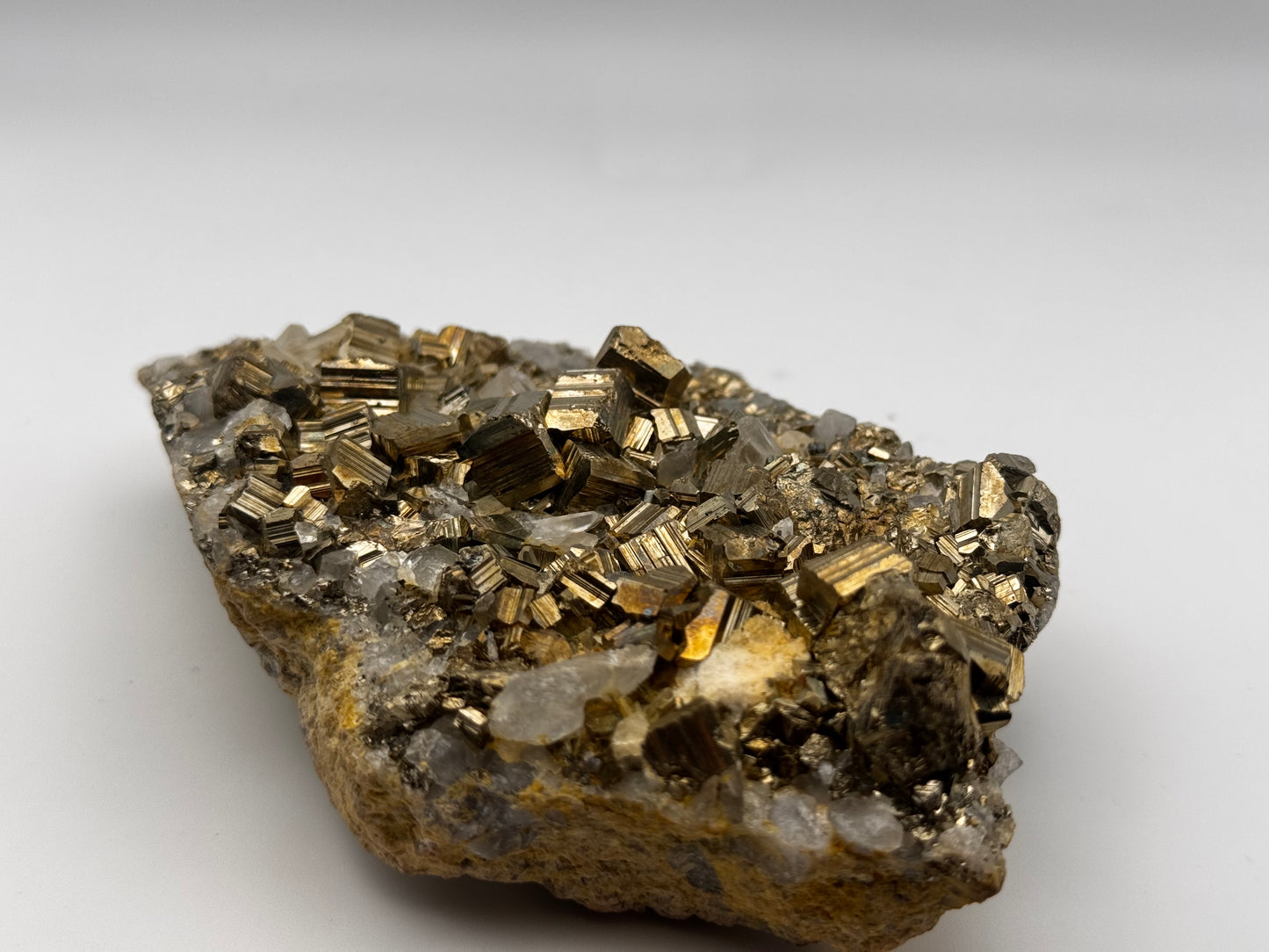
Pyrite & Quartz Mineral Association
Product Overview
This substantial specimen features a complex association of Iron Pyrite and Quartz. The piece showcases the geometric precision of the Pyrite—known for its metallic luster and brassy-yellow hue—intergrown with the crystalline structures of the Quartz. The contrast between the metallic cubic formations and the translucent quartz matrix highlights the distinct crystallization processes of sulfide and silicate minerals occurring in unison.
Origin & Formation
These associations typically form in hydrothermal veins or within metamorphic environments where mineral-rich fluids circulate at high temperatures. The Pyrite crystallizes in cubic or pyritohedral habits, while the Quartz forms the foundational matrix or grows in tandem as prismatic crystals. Significant deposits of this mineral combination are found in high-altitude mining regions, most notably in the Andes Mountains of Peru or the Ural Mountains.
Specifications
-
Minerals: Natural Iron Pyrite and Quartz
-
Dimensions: Approximately 5.5" x 4"
-
Luster: Metallic (Pyrite) and Vitreous (Quartz)
-
Form: Intergrown Crystalline Cluster
-
Weight: [Insert Weight]
Key Features
-
Aesthetic Contrast: The brilliant gold-toned metallic luster of the Pyrite provides a sharp visual counterpoint to the neutral, translucent Quartz.
-
Large Display Size: With dimensions of 5.5 by 4 inches, this specimen is sized for prominent display in a professional collection or as a sophisticated interior focal point.
-
Geometric Complexity: Features well-defined crystal faces and sharp angularity, showcasing the natural architecture of both mineral species.
Important Notes
Pyrite is a heavy mineral; please ensure your display surface can support the weight of this substantial piece. As a natural geological specimen, it contains unique growth patterns and minor variations inherent to its formation.
Share