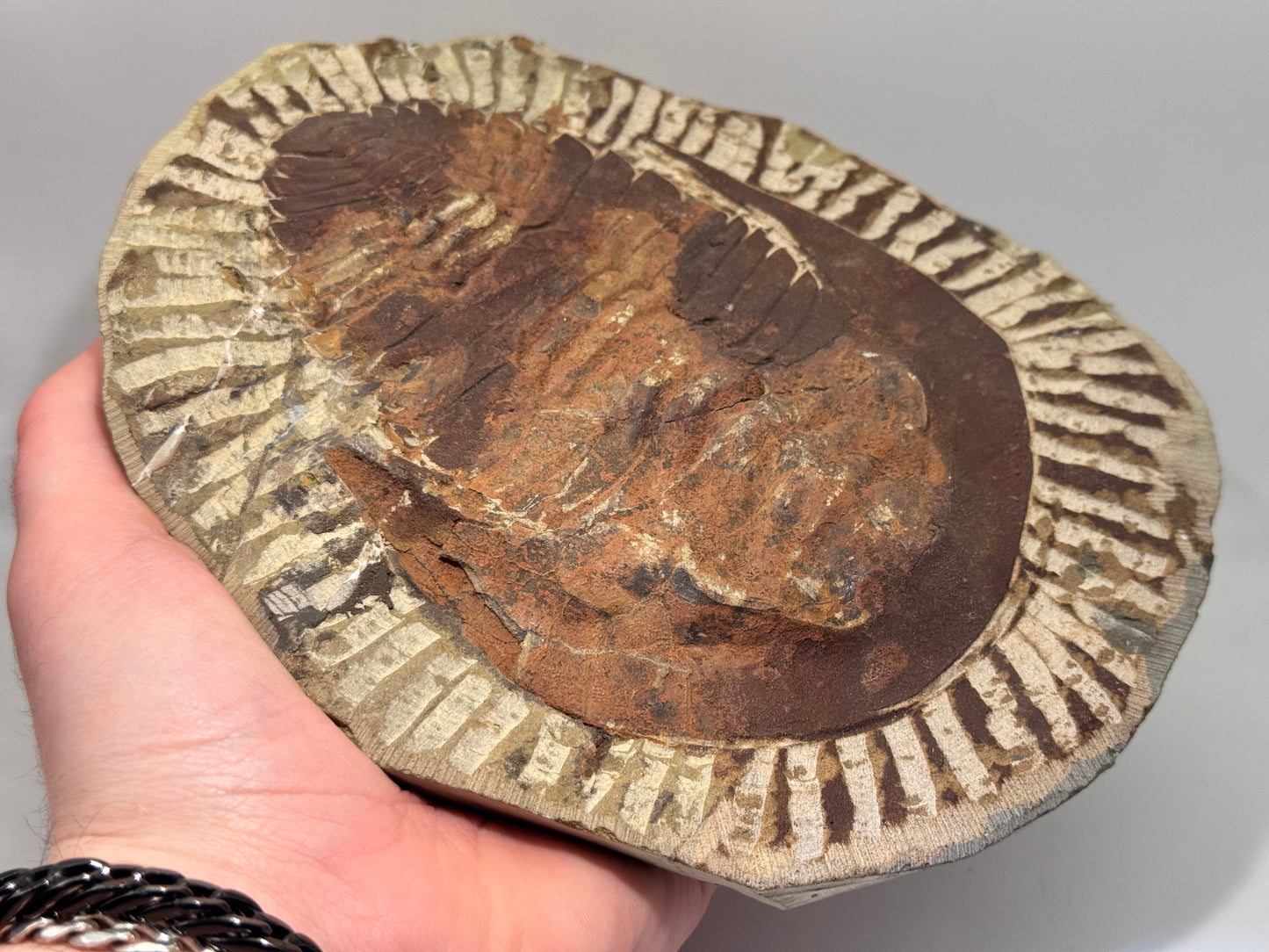
palm sized trilobite
Couldn't load pickup availability
Product Overview
This impressive 7-inch Trilobite fossil is a remarkable relic from Earth's ancient oceans, dating back hundreds of millions of years. As a large-scale specimen, it showcases the intricate exoskeleton of these extinct marine arthropods in stunning detail. The fossil features a well-defined cephalon (head), thorax (body segments), and pygidium (tail), making it a significant centerpiece for any paleontology collection or natural history display.
Origin & Location
-
Source: Large trilobite specimens of this caliber are commonly unearthed from the fossil-rich Atlas Mountains of Morocco or the Wheeler Shale in Utah, USA.
-
Geology: These specimens are typically preserved in limestone or shale matrices, where the organic matter was replaced by minerals over eons, turning the creature into stone while preserving its original anatomy.

Specifications
-
Specimen: Trilobite (Class Trilobita)
-
Length: Approximately 7 inches
-
Era: Paleozoic Era (Cambrian to Devonian periods)
-
Matrix: Natural host rock (Limestone or Shale)
Key Features
-
Substantial Scale: At 7 inches, this is a "trophy" sized fossil, far larger than the common smaller varieties, allowing for a clear view of its prehistoric physiology.
-
High Relief: The specimen is professionally prepared to stand out from its matrix, providing a dramatic three-dimensional appearance.
-
Exceptional Preservation: Displays visible segments and ocular structures (eyes), offering a rare glimpse into the biology of one of the most successful early life forms on Earth.
Important Notes
-
Handling: While the fossil is stone, the edges of the segments can be delicate. It is best displayed in a stable environment away from high-traffic areas.
-
Natural Variation: As an authentic prehistoric artifact, the fossil may show natural fractures or professional stabilization marks, which are standard in the preparation of large-scale specimens.
-
Cleaning: Dust lightly with a soft, dry brush. Do not use water or cleaning agents, as these can penetrate the porous matrix and damage the fossil over time.
Share